

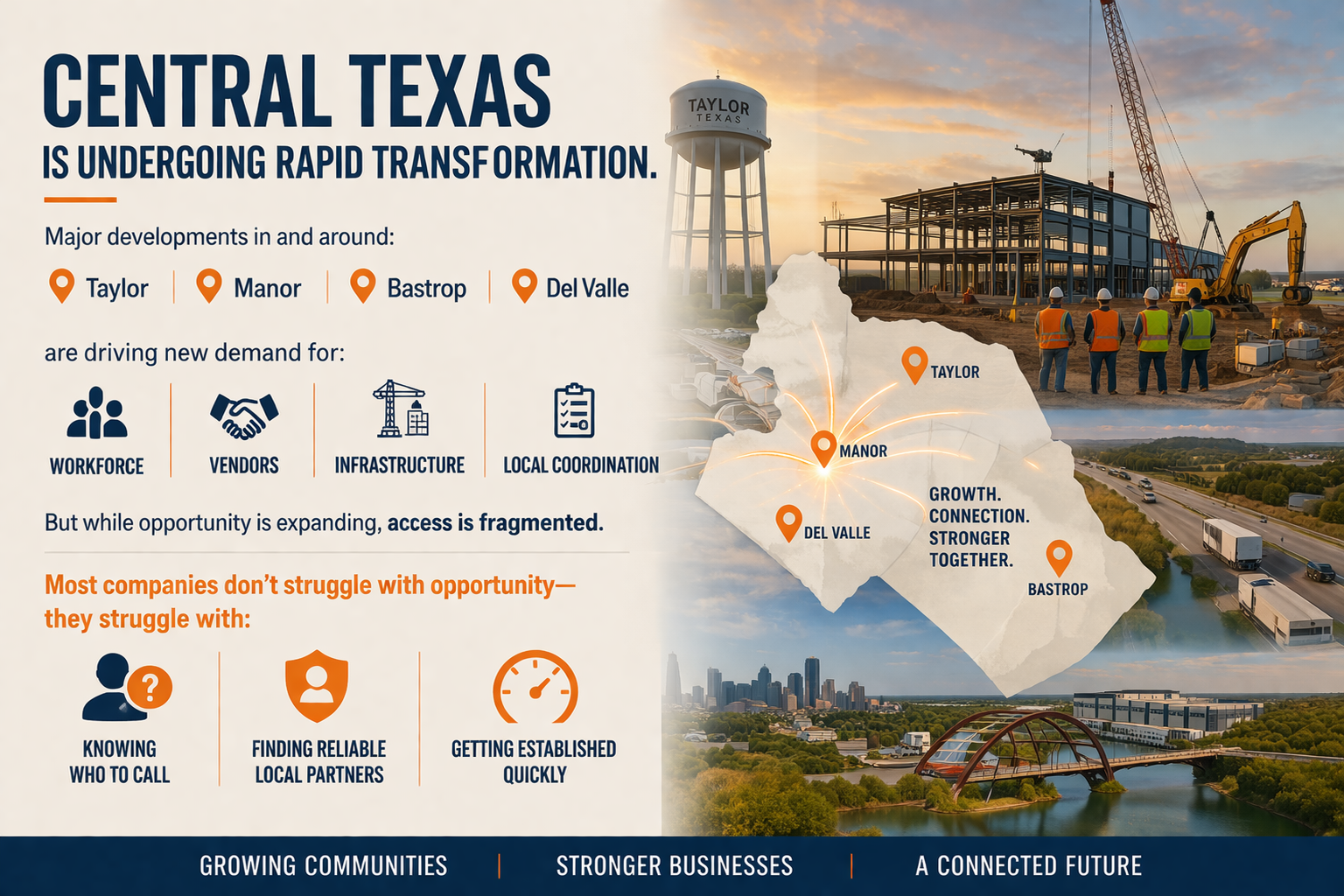
On the surface, the Taylor Corridor looks like pure opportunity.
Major investment is flowing into the region. Industrial development is accelerating. New companies are entering the market, and the long-term outlook is strong.
But once a company actually begins operating here, the reality shifts quickly.
The challenge is not growth.
The challenge is access.
Most companies come in expecting that if the opportunity exists, everything else will fall into place. Workforce will be available. Vendors will be easy to identify. Logistics will come together with enough effort.
That assumption is where the friction begins.
Where the Breakdown Happens
In a fast-growth industrial corridor, the problem is not whether resources exist. The problem is whether you can access them—quickly, reliably, and at the right scale.
Companies typically run into the same issues:
- They cannot find dependable labor fast enough
- Vendor sourcing takes too long and lacks reliability
- Housing for incoming teams becomes a last-minute scramble
- Local relationships take time they do not have
- Coordination across all of this becomes fragmented
None of these issues are catastrophic on their own. But together, they slow everything down.
Projects get delayed. Costs increase. Teams become reactive instead of focused.
The Real Bottleneck
The real bottleneck is not capability.
It is not capital.
It is not even demand.
It is access to the right people and resources at the right time.
This is what most outsiders misunderstand about markets like the Taylor Corridor. Opportunity does not automatically create efficiency. In fact, rapid growth often creates the opposite.
When demand rises faster than coordination, friction becomes the default.
What This Means for Companies
If you are entering or operating in this market, your success will depend less on what you bring internally and more on how quickly you can connect externally.
- Who can you call when you need 25 workers this week?
- Who are the vendors that actually show up and deliver?
- Where do you house teams without disrupting operations?
- How do you coordinate all of this without losing time?
These are not side questions. These are operational questions.
And they determine whether you move forward—or stall.
The Shift That Needs to Happen
Companies that succeed in this environment understand one thing early:
They do not try to build everything from scratch.
They prioritize access.
They plug into local networks.
They shorten the distance between need and execution.
Because in a market like this, speed is not just about decision-making.
It is about how quickly you can get what you need to operate.